Sunday, October 20, 2013

PARTAY for the ANCESTORS & WATER WATER EVERYWHERE

October in Cambodia feels like an ongoing festival. Every week something seems to be celebrated. The last 3 days of the 15-day long Pchum Ben holiday kicked off the month (3rd, 4th, and 5th), the Commemoration Day of the King Father, Norodom Sihanouk who passed away last year (15th), the Paris Peace Accords Day (23rd), and then King Norodom Sihamoni’s Coronation Day (29th). Schools across the country attempted to reopen at the begin of the month despite the cluster of holidays, widespread flooding issues, and not having the results of the 9th grade national exams (taken late due to political protests, thus pushing back the release of the results which determine whether students repeat 9th or pass on to 10th and officially high schoolers). Combine all of those factors and what do you get? A changing school schedule (a real moving target) and general confusion on the part of teachers, students, parents, etc. awt dung pong, pontie awt tai tay! (in essence: “I have absolutely no idea, but it’s okay.”) So how did the school’s (delayed) reopening affect me as a health volunteer? Well first of all, I have found time and time again that health messaging can be very effective on youth when presented in an engaging way. Making health education and key points sticky is crucial and from my experience youth often eat it up (like sticky rice!)! As a result I have found going into the schools and talking with students in a formal and informal way very productive. I like to think of myself as an idea farmer (thanks to my incredible program manager, An Thy, for giving me this analogy) - I spread and plant ideas and where and when they take root, I continue to water and care for them. Students often engage with those ideas and allow them to take root or spread them further. So I try to triangulate and get a better understanding of the school schedule for myself, so that I can start up the girls’ club again* and tutoring with the ever-increasing busy, loak gkruu Sean,  and to help my site-mate, Emily. So much of life in my community revolves around the school, farming, migration, and holidays. Anyway, I am confident that school will kick into high gear this coming week… maybe.
As I reflect back on the past year, I can recognize how far I have come. An easy measure of that was my experience with Pchum Ben this year versus last. I was down and out with a bad head-cold for the final days of Boh Bai Ben - the days leading up to the end of Pchum Ben - and so I opted out of the 4am wake ups to throw balls of sticky rice into baskets around the wat to feed the ancestors after listening to monks chant while your legs are falling asleep curled underneath you.* It poured almost the entirety of the first week of October, so my host cousins and siblings opted out for all but one of the early mornings. While I missed the opportunity to compare that experience to last year, the large extended family meal to mark the end of Pchum Ben and the final morning ceremony at the wat felt like déjà vu, besides my reaction to them. I would like to think significantly less awkward. I knew what I was getting into (at least in vague conception) and I felt more comfortable to engage with others thanks to improved language, knowing more community members, and a stronger bond with my host family. So strolled over to the wat with my sister, Ong, and neighbor, Haseka, carrying the 4-tiered silver canister holding different food dishes and a substantial amount of rice (I say substantial because the amount could feed me for 2 days but to which the average Khmer teenager would devour in a meal…), and some Riel (Khmer currency) for the monk offerings. This is the community (including extended family members visiting and those back from working in Thailand) lined up waiting for the monks to pass and daak baat into their offering bowls. The orange or maroon robe clad monks are followed by the yeays  (“wat grannies”) all in white. 

As you can see everyone tries to dress to impress traditionally in white tops and sampots or skirts for women and khakis or dark pants for men. While I pull out the same outfit for every similar occasion other wear elaborately embroidered and bedazzled light colored tops which are the norm for weddings.
Back at the house families gather together for communal meals, a significantly less awkward affair this year which may have been due to the fact that this year I was lucky enough to sit at the kid’s “table” (on the plastic rice mat, legs bent behind) and giggle the whole time. I was definitely more courageous with my food selection as well.


An extra treat this year was a trip with my aunt (Ee Roth), uncle (Boo), sister (Ong), cousin (Srey Ny), and a group of 4 teenage boys who work and live at the car/moto wash that my aunt and uncle own. We went to the Cambodian Cultural Village in Siem Reap - a “learn about the people of Cambodia” cultural center with a distinctly Walt Disney feel to it. A very unique experience to do seemingly touristy activities with members of my host family.

As I mentioned before, flooding has wrecked havoc across the country and the casualties have been high and 2013 is being called the worst flood year in Cambodia’s history. The monsoon season started to slow down post-Pchum Ben and the water has begun to recede a bit, but not before I had the chance to travel with staff from the Operational District (OD) Health Office to a “floating” health center that serves 2 “floating villages” that had been under my health center’s service area until just before I arrived at site. The health center in Treeay is small and thus is still supported by my health center, currently an hour plus motorboat ride and 6km moto ride on a beat-up dirt road away. Talk about access to care issues. I went on this excursion with 5 OD staff and my HC director, Boo Phally. All men and the foreign woman. It was a fascinating adventure - water water as far as the eye could see but which dissipates significantly during dry season - and I was impressed by the OD staffs interactions with the HC staff, providing coaching, refresher training, etc. I got to meet my host sister’s aunt and cousins who live in the floating village, have a meal of fish and eel caught then and there and morning glory gathered by one of the OD staff during a quick swim, circle the floating wat in the village, and see 8-9 different varieties of birds living in mud nests in the watery expanse. The whole day was a reminder of how much of my community and the surrounding area there is still to get to know. Forever learning and exploring.


I love water. I can count the number of times that I have swam in the past year on one hand. That all changed this past month as I started taking kids up on their invitations to swim in the stream that flows N-S through my community and the rice paddies. From a hygiene and sanitation stand-point… well let’s just say that I bucket shower with vigor post swim. K7 Joel came to visit a couple weekends ago to eat homemade pizza (sans cheese) and engage in a spontaneous playtime with the entire neighborhood it seemed. Emily, Joel, and I played on the new elementary school  playground , organized relay races, and cooled off with a swim in an area shallow enough for the little ones to be able to stand (many Khmer children do not know how to swim, attempting to teach swim lessons J) and yet still be launched from our shoulders, backs, thighs, etc. to belly flop or cannonball into the water. I definitely got an upper-body workout from throwing some 25 different kids over and over. (Reminded me of my swim lessons with my brothers and Dad growing up.) I foresee many more such play-dates in the future.


Bon Oam Touk or Water Festival (cancelled for the 3rd year running in PP, but allowed on the village level) is known for long boat races. Lucky for me I got to experience this early, when Emily and I went to visit a fellow PCV, Jeff, about 60km NW of us on a recent day off (Commemorating the late King Father). The trip was smoother than I could have ever planned with a seamless transfer from taxi to pick-up truck at the district town of Kralanh. At Jeff’s site, we walked around meeting his community and ran into the previous PCV, Blair’s Camp GLOW counterpart, a spunky academic named Sochea who will be away from her family for the next year to pursue more education to improve her teaching and pay grade level in PP. Super inspiring! Wandering around we got to climb into the bell-tower of an ancient wat and stumbled upon a super competitive long boat race in a channel amongst the rice paddies. The young boys - with Olympic rowing potential! - allowed us to join in as dead weight at first before realized we could be put to use and paddle, although our boat still only ended up winning half of the races. After lunch of fish and lotus stem soup (somlah m’chew) with Jeff’s host family and sticky rice and smoothies at a roadside stand Emily and I made the return trip.


I think one thing that is significantly different in my approach to this year versus last year, is my willingness or eagerness to engage playfully with those around me. I am comfortable niyeay layng -ing or “joking” and playing with the language, but more importantly I am not taking myself so seriously, going with the flow, and spending time smiling and laughing. I am vulnerable. Undoubtedly. But this year I have chosen to recognize and own my vulnerability instead of hiding behind it. Mistakes and miscommunications are a part of the process of life, so why not learn through playing the game? 

Friday, October 11, 2013

Today is International Day of the Girl Child.

Every week Peace Corps Cambodia sends out a weekly update (WU). In it one of the incredible Khmer staff does a bit about language and culture. In conjunction with the Gender and Development (GAD) Committee, this week Borin spotlighted International Day of the Girl Child. He did such a phenomenal job and I love how you can see the khmer translations and English phonetics too. So enjoy some language and culture exchange while you think about what this day means to you and to people around the world. (Also I highly recommend the Half the Sky: How to Change the World by Nicholas D. Kristof & Sheryl Wudunn for an eye-opening account of gender issues and crimes against humanity and the importance of education, especially for girls the world over. 

Language and Culture Corner:  International Day of the Girl Child
On December 19, 2011, the United Nations General Assembly adopted Resolution 66/170 to declare October 11 as the International Day of the Girl Child, to recognize girls’ rights and the unique challenges girls face around the world. The term “girl child” is commonly used abroad to distinguish the unique challenges faced by those under age 18 from those faced by women. The most common factors that contribute to the challenges that girls face are poverty and lack of education. Cultural beliefs and values and family support contribute to whether girls will receive greater levels of education. 

Vocabulary Corner

Vocabulary
Khmer Translation
Phonetic Symbol
International Day of the Girl Child
ទិវាកុមារីអន្តរជាតិ
Dti wae komaarey antarakcheat
recognize
ទទួលស្គាល់
Dto dtuol skorl
declare
ប្រកាស
Bpro kaas
girls' rights
សិទ្ធិរបស់កុមារី
Sithi robos komaarey
Unique
តែមួយគត់
Te muoy kut
challenge
បញ្ហា
Bpaagn haa
common
ទូទៅ
Dtoo dtov
factors
កត្តា
Kataa
poverty 
ភាពក្រីក្រ
Phaep krey kro
lack of education
ការខ្វះការអប់រំ
Kaa k’wah kaa orbrom
cultural beliefs and values
តំលៃនិងជំនឿខាងវប្បធម៌
Dtom lai noeng chum neu khaang waab thor
family support
ការគាំទ្រពីគ្រួសារ
Kaa kom dtro bpi kruo saa
social change
ការផ្លាស់ប្តូរសង្គម
Kaa p’laas p’doa sangkum
benefit
អត្ថប្រយោជន៍
Aat thaak bpro yorch
Influence
ឥទ្ធិពល
Et thi pul
improve
កែលំអ, លើកកំពស់
Ke lum or, leuk kam pus
human trafficking
ការជួញដូរមនុស្ស
Kaa chuogn doa momuos


Discussion Questions:

1. How can families encourage girls to continue their education?

តើគ្រួសារអាចលើកទឹកក្មេងស្រីអោយបន្តការសិក្សារបស់ពួកគេយ៉ាងដូចម្តេច?

2. What benefits do families gain by helping their daughters finish school?

តើគ្រួសារបានទទួលអត្ថប្រយោជន៍អ្វីខ្លះពីការជួយអោយកូនស្រីរបស់ពួកគេបានបញ្ចប់ការសិក្សា?

3. How do communities benefit by educating girls?

តើសហគមន៍ទទួលបានអត្ថប្រយោជន៍អ្វីខ្លះពីការអប់រំក្មេងស្រី?

4. How do civil rights impact the opportunities you have?

តើសិទ្ធិរបស់ជនស៊ីវិលធ្វើអោយប៉ះពាល់ដល់ឱកាសទាំងឡាយដែលអ្នកមានយ៉ាងដូចម្តេចខ្លះ?

5. How does a girl’s legal status impact her opportunities?

តើសភាពស្របច្បាប់របស់ក្មេងស្រីធ្វើអោយប៉ះពាល់ដល់ឱកាសដែលនាងមានយ៉ាងដូចម្តេចខ្លះ?

6. How can individuals and organizations effect change?

តើមនុស្សទាំងឡាយ និង អង្គការនានាធ្វើអោយការផ្លាស់ប្តូរកើតឡើងបានយ៉ាងដូចម្តេច?

Additionally, here is the message from the GAD Committee: 

As Borin mentioned in his Language Corner, today (October 11th) is the International Day of the Girl Child. We encourage you all to talk it up in your communities and here are some cool resources that you can work with. If you use the Curriculum, do a Public Art Display, have an educational session or an interesting conversation with a counterpart, student, friend, host family member, etc. we want to hear about it. Let us know: pccambodia.widgad@gmail.com. Also you can find this information on the GAD blog: http://pckhmerwidgad.blogspot.com/ .


Girl Rising (http://girlrising.com/). This inspiring  film tells the stories of nine girls from across the world who have found the courage to challenge the bounds that society and circumstance placed them in, from poverty to child marriages to cultural constraints and more. Directed by Academy Award nominee Richard Robbins, this film brings the reality of the lives of young girls in the developing world to light in a powerful way. Through education, self-determination, and unconquerable spirit, these young women are changing their lives and helping others do the same.

One of the nine girls is Sokha. “This is not the end. It is the beginning.” Sokha was a Cambodian child of the dump: orphaned and forced to pick through garbage to survive. But, through a series of miracles, Sokha finds her way to school – and, like a phoenix, she has risen to become a star student on the brink of a brilliant and once unimaginable future. Sokha's story is written by Loung Ung. Loung is one of the most powerful voices to emerge from modern Cambodia. An orphan of the Khmer Rouge, she fled Pol Pot's brutal regime at the age of 10. Loung's bestselling memoirs have brought home the tragedy of Cambodia for millions of readers. Through the lens of her own extraordinary experience, she speaks directly to the fractured reality of her country as the past continues to reverberate through the present.

WHAT CAN YOU DO? 
There is a Girl Rising Curriculum! http://girlrising.pearsonfoundation.org/?id10x10=E003622C34F5F884 for 5th graders all the way to college students. Although the curriculum has some focus on 2 stories of girls from Nepal and Peru, the curriculum can be adapted to focus on the Khmer part of the film. The film will be available at our post soon, but don't let that stop you from doing activities now (or whenever). The film is not in Khmer unfortunately - a great resources for you English Teachers maybe! You can also use this curriculum without showing the film and adapting the lessons to be discussion based. 

Create your own event and get resources to help! http://10x10act.org/idg/ and register at that site!

Sunday, September 29, 2013

Facilitation and Meet-Ups


I seem to be bouncing between trainings recently. After MST, I had a quick break before I participated in a Training of Facilitators (ToF) in Siem Reap lead by an INGO that works in my community. In my area, the INGO is currently going through extensive personnel changes and now have to implement a year-long project that is being rolled out in 2 districts in 4 different countries around the world (top-down?). The pilot program focuses on maternal, neonatal, and infant health in an attempt to assess the INGO's effectiveness at creating positive change in the communities in which they work. The staff in Siem Reap and Phnom Penh have asked me to help out with the project that includes health technical training for the Village Health Support Group (VHSG) and Time and Targeted Counseling (TTC) for pregnant women and their families through the first year post delivery. 

Barriers on the Road to Behavior Change
The PC health framework aligns almost perfectly with this project and I have been trying to work with this INGO for a while, so it is nice to finally team up. And yet I have a lot of issues with this pilot - and so do the Ministry of Health people at the provincial and district levels. The theory is there, the execution and acceptability at the local level are questionable. And here in essence lies one of the hardest parts of international development and aid. As I mentioned in my last post, as a Peace Corps Volunteer I am able to occupy a space and play a role in community development that is quite unique. As such, I aim to be a connector, a resource, and help bridge that gap between theory and application. I am interested to see how this project pans out (for better or for worse) and to learn from this experience. 

After the ToF ended I met up with the new group of K6-K7 Siem Reap volunteers for a weekend of exploring, bonding, good food and conversation. All but one volunteer made it in. Here are some photos for the activities we ended up doing. 
the wonderful K7s! Joel, Rachel, Jeff, and Emily
K6 sandwich! Rachel (K7), Pete (K6), Me (K6), and Joel (K7)
fish massage!
Angkor Wat mini golf!
Most of the Siem Reapers :)

Saturday, September 28, 2013

Constitutional Current and Street Swimming

This past week marked the 20th anniversary of Cambodia's Constitution. In 1993 the newly elected National Assembly was convened and UNTAC (the UN Task Force) started to pull out of the country. Fast forward to 2013 and last Monday when the new members of the elected government were sworn into the National Assembly... well 68 of them. Where were the remaining 55 members you ask? They were hanging out at Angkor Wat (about 340km north of the capital) in protest. The opposition party has made it clear time and time again, despite negotiations that seem to reach an understanding of the election results, that the July 28th elections were not free nor fair. The majority of the international community and human rights groups in Cambodia seem to side with this view although there has been some impatience to hurry up and work together already. (Conversely, China has publicly endorsed the official results issued by the ruling party.) So the National Assembly convened on Monday without the members of the CNRP who had won seats. Since then the leaders have agreed to resume negotiations (http://www.phnompenhpost.com/national/cnrp-ready-talk), all the while encouraging demonstrations and protests from their supporters (http://www.cambodiadaily.com/elections/cpp-victory-ratified-cnrp-promises-more-protests-41898/). It is a vast oversimplification to say that as a result (cause and effect) there have been clashes with police, peaceful demonstrations and hunger strikes that have turned violent. But this has happened. And all of this in more urban areas where a variety of media sources and public opinions are more accessible. The news that is available to the rural populations is regulated by the government and limited. In my community there is a overwhelming majority of people who tell me that the CPP won. End of story. I have asked people what they think of the protests and demonstrations, the violence and the negotiations and I often come across a lot of confused looks. From my experience there is generally a gross unawareness of what is going on once you are removed from the capital and major city centers.

I do not know what will happen and when the two-party government will actually come together as exactly that - a two-party government. In the meantime there are seats that need warming. If the opposition does not warm them, it is unclear who will claim them.

While the urban areas are concerned with government leadership, the provinces are dealing with an uncertain situation as well: flooding. A generally mild rainy season has taken a sharp turn to severely swamped. Flooding has reached epic proportions in watersheds across the country and every time I check the death toll seems to rise (http://www.phnompenhpost.com/national/floods-could-surpass-%E2%80%9996-levels). Because Cambodia is primarily an agrarian society, these drastic change in weather have had some damaging effects on livelihoods.

Recently, I attended a training lead by a mixed team of host country nationals and foreigners (more on that later...). I got to talking with one of the foreigners and he asked whether I liked dry or wet season better. Having been born and raised in the greater Seattle area, I have a great appreciation for rain and its beauty. As I see the negative effects that the rainy season has on the less fortunate, I have come to realize how privileged I am to be able to say that I like wet season better; as I have the option to be removed from the elements if I so chose. I went for a long run in Siem Reap during a drizzle yesterday and got out past the city limits a bit and made the mistake of turning down a flooded street. I quickly found myself in water up to my knees. Along with others on bikes, motos, and in cars I waded through contaminated water comforted by the fact that I had clean drinking and bathing water to go back to when I returned to the guesthouse. I was able to laugh at myself and to joke with people gawking at me, the barang, very nearly swimming past their front doors.
swimming anyone? a flooded street in Siem Reap
Despite being a volunteer, I am comfortably living on a volunteer stipend that allows for me to come and go between what often feel like separate, disconnected or maybe even dissonant worlds. One in which flooding is a thing that is understood objectively or in theory, as an observer, and one in which the reality of the flooding has everyday implications. I met someone in the foreign service recently who addressed this concept by saying that "Peace Corps Volunteers are lucky to be in the field and to be working and living in that liminal space." While most days I feel extremely lucky, I also struggle to bridge and process those multiple worlds.

Look out for a less meta post on our first K6-K7 provincial meet up paired with more musings on different approaches to international development...

Sunday, September 22, 2013

Mid-Service Musings

Writing has always been an outlet of sorts for me. A way to process, a therapy, a form of expression. I journal A LOT. My family sent me a new journal for Christmas (which arrived in mid January thanks to the delays of the international postal system) because I had filled up the one that I had brought to Cambodia within the first 4 months. This one is special because it has a page for each day, with a big heading at the top. Unfortunately (or fortunately) I am a bit compulsive which translates in this situation to having the need to fill every page and thus the compulsion to write and document everyday. When I first got the journal I was already behind and I had to think hard to back track and remember. When I returned to site after having battled Dengue in July I had to fill in the gaps despite having done little during those 2 weeks in bed. And now? I am a month behind. Why? Because of so many things and none of which have to do with a lack of time nor emotions nor excitement. Instead, I have started documenting the memories and moments in different ways - like at least a photo-a-day, emails to loved ones, phone calls to fellow PCVs, etc. But most importantly my need for an outlet for processing emotions alone is seemingly less essential to my happiness here. I feel centered and able and willing to question issues I see and difficulties I encounter with the people around me - not only with other PCVs and staff, but with my host family, and people in my community. My relationships are developing further and my conversations have deepen. I feel connected and supported. I have hit what our Country Director describes as the sweetspot (my Khmer translation kon layng p'ime).

And just about when everyone told me I would. It is now past the 1-year mark. I arrived at my site on September 10, 2012. I have less than a year until my Close of Service (COS). There is still a lot to learn and do before I will be prepared to leave my new home behind (if you can every really leave something like that "behind"). One way that Peace Corps marks points of service is with trainings. Last week I found myself traveling down to Phnom Penh unsure of what was going to really be in store for our mid-service training (MST).

The barbwire police barricade removed Tuesday near the office.
The 50 remaining volunteers in my cohort (K6) - we started out with 58 - converged on a nice hotel last Sunday and had a packed 3 1/2 day schedule of professional development held at the Peace Corps office. Actually the first day was held at the hotel because of protests (remember all those posts about the elections?) from the opposition party, the CNRP, throughout the city. That is a whole nother post...

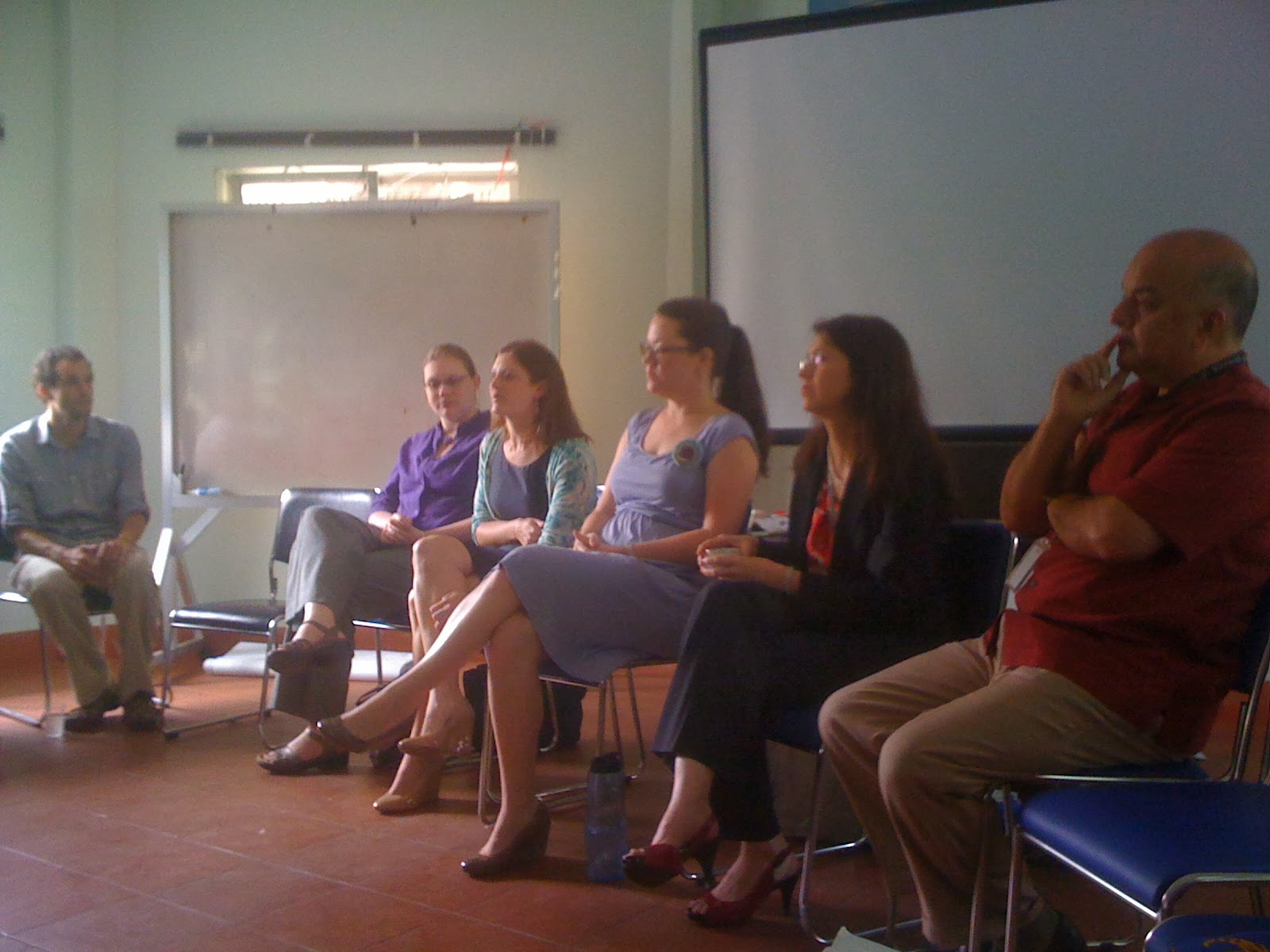
Incredible panel talking about diversity in Cambodia
So what happened during MST? We had sessions on administrative procedures, Khmer history and Post-conflict legacies, diversity in Cambodia, safety and security, engaging counterparts, resources of students, technical language, activities for the classroom, health curricula, democracy and governance in Cambodia, core expectations, motivations of service, secondary projects, foreign service and post PC opportunities, and grant writing.

Motivations of Service with our DPT, Alissa
A tough session with our fearless PCVL, Sean
language lessons with our LCC, Borin
Foreign Service and other post-PC opportunities led by our DMO, Erin
Small group lunch with our PM, An Thy

There were opportunities to meet individually and in small groups with staff members and an open space for sharing successes and challenges. And to top it all off we had a boat cruise on the Mekong with the staff. I got to meet new faces and reconnect with "old" friends (did I really just meet them last year???).

Hanging out in the lounge between sessions


We each brought something unique to the MST; new perspectives and experiences. I was reminded that I am lucky to be in the field; that it is not about putting up big numbers, but about the dignity of people and the process; to give all of myself - everything that I can at this point in time; and that everyone has a story.


I know that this next year is going to fly by. MST seemed like something in the future and now it is a thing of the past. I understand why Peace Corps service is a 2 year commitment, because a year just isn't enough. I am so grateful for the time that I have had here thus far and firmly believe that this next year will bring with it so much more than I can even anticipate.
Getting by with a little help from my friend, Kelly

Sunday, September 15, 2013

New Kids On The Block

Last weekend forty-six more people joined the ranks of the PCVs in Cambodia. A prestigious club for sure. I was not in attendance for their swear-in, but the ceremony was televised and broadcast across the country.

One of the reasons I did not head to PP for the ceremony was because of political demonstrations/rallies  by the opposition party, CNRP. That weekend the National Election Committee announced that the official election results were the exact same as the original preliminary count on July 28th. This was not what the opposition nor the NGOs claiming that the election was not free and fair, wanted to hear. As a result a string of events have followed - meetings with the King and party leaders, a small explosion near the National Assembly, tear gas and riot police for the 20,000 strong demonstration, and currently a 3-day planned protest that has already seen conflict arise. The National Assembly is supposed to reconvene on Sept. 23rd. We shall see what actually happens.

Back to talking about the K7s (new PCVs)... I HAVE A SITE-MATE! Her name is Emily and she is a English Teacher (ETTT). This past week I have spent some time getting to know her and showing her around, although she would be a superstar without me. She is living a block or so down the road at the head midwife's house. Although school doesn't really start until after Pchum Ben (Khmer festival in early October), Emily has already dived right in and started tutoring people around the community in English. I am excited to be sharing my community with her and collaborating on projects with her in the future.
site-mate goofing-around session :)
In addition to Emily, new-comers Joel (CHE), Rachel (ETTT), and Jeff (ETTT) are now officially Siem Reapers. I have visited Joel and Rachel who live about an hour bike ride in opposite directions from me and I hope to make my way to Jeff soon. Here is a photo from my visit to Joel's. 
Joel with his home decorating (courtesy of host family)
And now I am in PP (despite the protests) for our mid-service training. I biked from site to Siem Reap - a muddy and wet adventure! - and then bused down to PP. Four days of MST here we come!
monsoon season doesn't stop me from biking all over.

Tuesday, September 3, 2013

THE BIG KIDS ON THE BLOCK

No I am not referring to the middle school boys that strut along Road 6 (the “highway” in front of my house). And I am not at all referring to the size of the people around me (as a general stereotype Khmer people a short and skinny, while this is changing as diets and lifestyles change and I do see bigger men and women and chubby infants, the stereotype is reinforced in my mind every time I am “reminded” by people in my community that I am fatter and bigger than they are…). Instead I am talking about how today marks the last Close of Service (COS) date for the group (K5s) ahead of me. As the K6s we are now the ones who have been here a year and have the experiences and knowledge that make us on top of the PCV food chain. We are the Seniors in a sense. Our country director, Penny, likes to say that we have hit the point in service (the one-year mark) when we are “arrogantly ignorant.” We think we know everything and yet simultaneously we are aware that we know next to nothing.

In June I said “see you later” to Jen. In July I watched as the first set of K5s COS’d, and two of my wonderful province-mates Tim and Katie move onto bigger and better things. Tim headed Stateside to get ready for his grad program in social work and Katie headed south to be the K7s PST tech trainer for the CHE program. This power couple on numerous occasions offered up their home to me, most notably for Christmas and for Katie’s Domestic Violence awareness training of trainers (ToT) workshop in March. Additionally they gave sound advice, suggestions, and support at the drop of a hat. Working with Katie on Camp GLOW was one of my highlights of service thus far. See her really stellar most recent post http://timkatstravels.wordpress.com/2013/09/02/tangled/ on the difficulty/near impossibility of summing up 2 years of service.
Katie & Tim (center)
Tim & Katie around their site
In August another province-mate and fellow Camp GLOW coordinator Mr. Blair hopped on a plan. Leaving the last of the K5s in Siem Reap to fend for herself.

Blair (left) riding the truck with Neysa and me.
Last week I got to say “so long” (I hate “byes”) to one of the most influential people I have ever met. I was truly blessed to have such a solid person and friend living only 25K down the road this past year. Granted I didn’t really realize all that Neysa offered me until the last few weeks and so I crammed as much Neysa-time as I could into the last month. Neysa is headed home to pursue a masters in non-profit management, something she clearly has a knack for. I was able to watch Neysa in her element at moments throughout this past year - working on workshops and projects, meeting with people in her community and the province, interacting with people who just thought the world of her, etc. - and I always came away from those experiences wanted to do more, and channeling that positive energy and her enthusiastic outlook on life. Neysa encouraged me to be more organized (and for those who know me - I was already pretty organized right?) and tackle new tasks and projects. She was unreasonably generous; inviting me to taco lunches at her site and most recently the going away party that her health center and host family threw for her with all the elements of a Khmer celebration - roasted pig, cases of beer, Karaoke, and dancing around a table. I was able to see her mastery of budgets working together on Camp GLOW and I helped her check off an item or two off of her Cambodia bucket list - including riding a buffalo at my site.

Neysa meeting baby Neysa. 

At Neysa's going-away partay. 


So as the K5s trickle down to Phnom Penh and fly off to meet their futures, I want to thank them all (especially Tim, Katie, Blair, and Neysa) for supporting and encouraging me, setting an example and being great role models, and more importantly being great friends. I hope that I can now take on the role of the big kid on the block and be what the K5s were for me, for the K7s.